

👋 Welcome to the new readers who’ve joined us since last week. You’re joining 176,000+ other subscribers who love fintech.
Howzit fintech friends,
GTA VI came out last week, and half of Lagos has disappeared into it. But the GTA Nigeria’s fintechs should be thinking about is a different one. Grand Total Access.
Last Wednesday, the House of Representatives passed an amendment to the Banks and Other Financial Institutions Act (BOFIA). The Senate passed its version earlier this month. A new section lets the CBN governor name non-bank firms “systemically important” if they get big enough by users, transaction value or market share, or if their failure could shake the wider system.
Once a firm is named, life changes. It faces stress tests, tougher governance and cybersecurity rules, more reporting and a spot on a public register. Then comes the part that gives this edition its name: the CBN gets direct access to its operational systems.
Nobody has been named yet, but everyone knows who was in the room. OPay came up in the debate. It has about 50 million monthly users and processed $358 billion last year, more than double 2024. Moniepoint is the other obvious name. These are no longer startups. They are the pipes.
Why now? Lawmakers are worried about concentration, about foreign money flows they can’t see, and about firms earning big in Nigeria without matching accountability. Add the CBN’s market-share cap, due on 31 December, and OPay calling off its New York IPO, and the direction is clear.
Is this bad for fintech? Not really. Banks have lived like this for decades, and being called systemically important is a compliment, because it means you matter. The cost is that the regulator now sits inside your systems instead of just reading your reports.
The bill still needs the President’s signature. Once he signs, the game changes for Nigeria’s biggest players. Grand. Total. Access.
— Jovin
Please find another week of fintech news below:
The Rundown
🏦 M&A
NGX Group acquired a 10% stake in the Nairobi Securities Exchange, extending its push into East African capital markets.
🚀 Product Launches
Archer launched an open fraud and AML library in Kigali, publishing 36 rules and seven regulation breakdowns, including Nigeria and Ghana.
Paystack unveiled plans at Solana Breakpoint to connect its African payments network to Solana, without naming a launch date.
Wave secured an e-money licence in the DRC, the first new entrant since 2015 in a market led by M-Pesa.
💸 Fundraises
First Circle Capital closed its $26 million fund for pre-seed and seed African fintechs, backed by IFC, Bpifrance and FSD Africa.
Connect Money raised $3.5 million pre-Series A to take its white-label prepaid card platform from Egypt into Saudi Arabia and Morocco.
Saviu Ventures closed its second fund at about $44 million to back fintech and other startups in Francophone Africa.
Sabika raised undisclosed funding for its Egyptian digital gold and silver platform, which says it has over 120,000 users.
PROTEGEY raised an undisclosed pre-seed round to build a shared fraud intelligence network for African financial institutions.
🗂️ Other News
Nigeria's House of Representatives passed a BOFIA amendment letting the CBN put large fintechs under bank-style supervision. The bill now needs the President's signature.
Kuda put about 7.5% of roles at risk in its second round of 2026 job cuts, as it targets profitability in 2027.
Safaricom confirmed a technical fault on Ziidi, its M-PESA money market fund, after customers could not withdraw or log in.
Uganda's Prime Minister ordered officials to draft a law on mobile money charges after summoning Airtel and MTN managers.
AfricaNenda reported that Africa's instant payment systems processed 71.4 billion transactions worth about $1.8 trillion in 2025, nearly triple 2021.
ECOWAS consultants proposed Nigeria as host of a regional instant payment system, with BCEAO handling settlement and Ghana as backup.
Valu slowed lending as its bad loan ratio rose to 1.20%, though nine-month net income still grew 35% to $13.7 million.
Afriland First Bank was given eight days to move about CFA142 billion, including funds backing MTN Cameroon's mobile money service.
UBA reported nine-month pre-tax profit of about $378 million (₦503 billion), down 13% year on year.
Hiring in fintech? We want to feature your role.
We’re launching the TWIF Fintech Job Board—and once a month, our editorial team will handpick and highlight the 10 most compelling, high-impact job openings across the industry in a dedicated roundup.
Whether you're making a critical founding hire, tackling tough technical infrastructure, or building zero-to-one, we want to hear about it.
Tweet of the Week
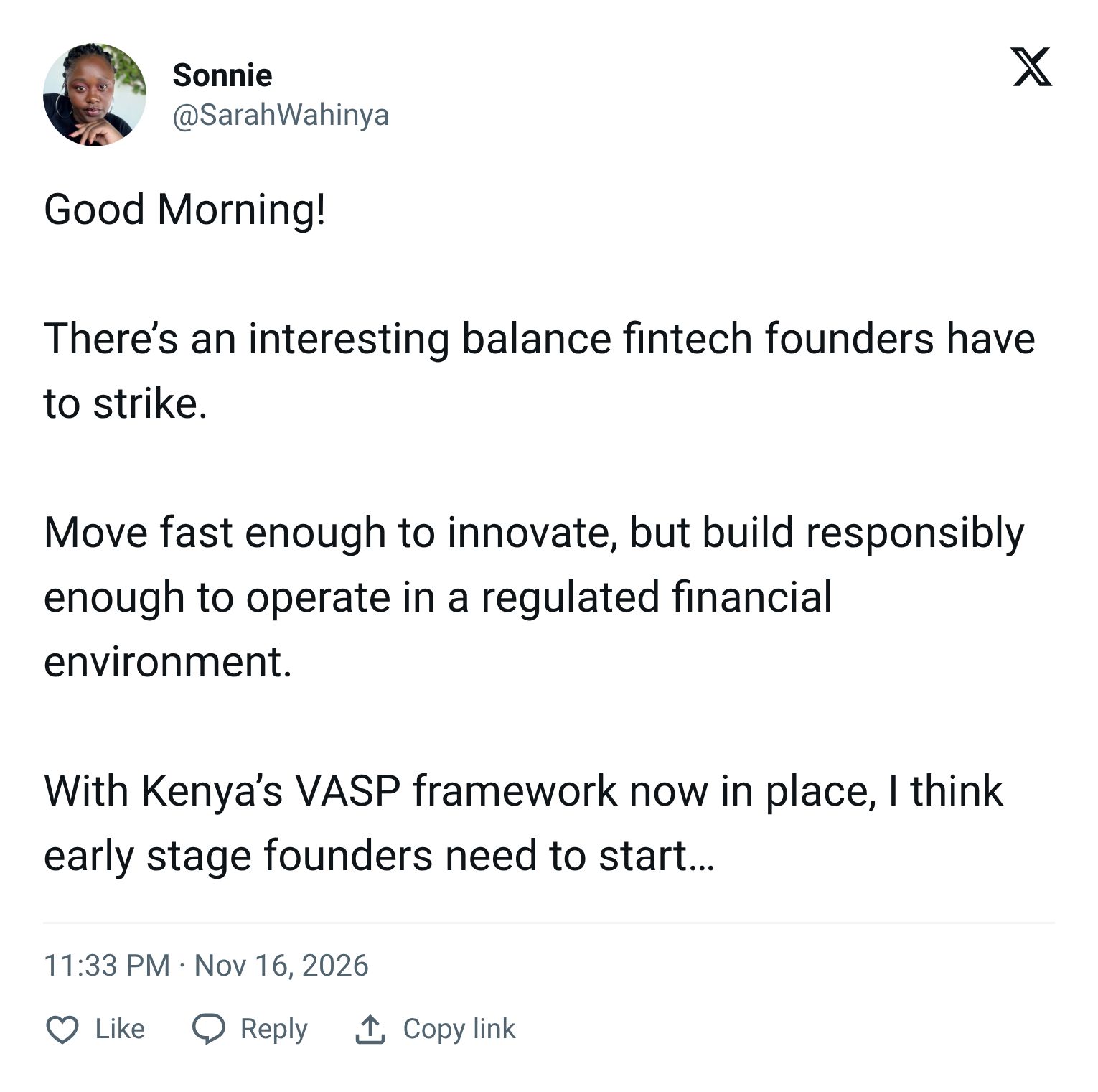
Paying attention?
Wave just won an e-money licence in the DRC. It's the first new entrant since which year?
a) 2009 b) 2015 c) 2020How many transactions did Africa's instant payment systems process in 2025, according to AfricaNenda?
a) 21.4 billion b) 48.9 billion c) 71.4 billionHow much did First Circle Capital close its African fintech fund at?
a) $26 million b) $44 million c) $54 million(The answers are in the closing remarks.)
Editor’s Picks

That’s all for today, friends. See you next Monday.
Asante.
Quiz answers: 1) b, 2015. 2) c, 71.4 billion. 3) a, $26 million.
